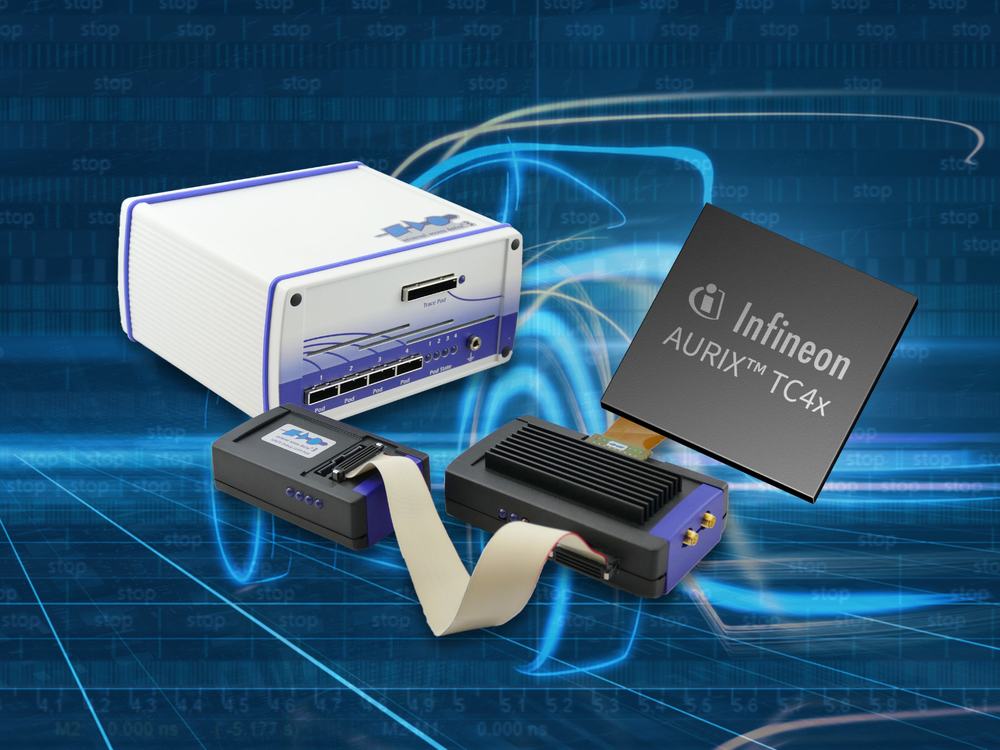
UDE® Offers Comprehensive Debugging and Trace Support for Infineon’s Latest AURIX™ TC4x Derivatives
Press Release
Lauta (Germany), October 06, 2026
The latest version of the UDE® Universal Debug Engine from PLS Programmierbare Logik & Systeme GmbH offers significantly expanded debug and trace functions for the AURIX™ TC4x microcontroller family from Infineon Technologies AG. In addition to the TC4Dx microcontroller, the first member of the MCU family, support for the TC48x, TC45x, and TC49x MCU variants is now available.
Manufactured using 28-nm technology, the TC4x MCUs offer powerful features for use in the next generation of vehicles and cover a wide range of automotive applications. Among other things, the individual variants can be used in zone controllers, integration platforms, in radar applications, or for xEV integration. The TC4x devices also meet the highest security requirements. For example, up to six TriCore™ TC1.8 cores can operate in lockstep mode. On specific devices, the PPU (Parallel Processing Unit) is integrated. This is a specialized accelerator core for AI applications or sensor fusion. The Hardware Security Module (HSM) from the TC3x series has been replaced by the significantly more powerful Cyber Security Real-Time Module (CSRM). The TC4x family also offers native support for virtualization via a hypervisor, allowing software to run free of interference. With the CDSP (Converter Digital Signal Processor), a core specialized in signal processing has been integrated directly into the MCU. In some variants, RRAM (Resistive Random Access Memory) is used as non-volatile memory instead of conventional embedded flash memory, offering significant advantages at smaller feature sizes.
Through its intuitive and therefore particularly user-friendly interface, UDE provides developers with easy access to all main cores and special-purpose cores of the TC4x family. The tool thus enables control of all cores for debugging, testing, and in-depth system analysis within a single debugger instance. It is therefore not necessary to open separate debugger instances for the various cores, such as the PPU or the CDSP. UDE enables high-level debugging of applications written in C/C++ as well as Rust code, with support for all common compilers. For debugging at the assembly level, the mixed-mode or disassembler mode can be used. In Mixed Mode, the machine code generated by the compiler is interleaved with the high-level language lines. For debugging the CSRM within the UDE, PLS also offers a corresponding extension package.
Depending on how the applications running on the TC4x are partitioned, the cores can be controlled either all together, in groups, or individually using traditional run-mode debugging, such as breakpoints or single-stepping. By utilizing the chip’s built-in debug logic, UDE enables the individual cores to be started and stopped almost synchronously. Furthermore, especially in shared code, multi-core breakpoints simplify the debugging of complex applications. A multi-core breakpoint always takes effect, regardless of which core is currently executing the specific code.
For non-invasive, in-depth observation and analysis of the runtime behavior of applications, UDE supports the trace system of the TC4x MCUs. For example, program execution across multiple cores can be recorded and visualized all at once, or data accesses can be monitored. When hardware virtualization is used, runtime information for individual virtual machines can be obtained. For example, this makes it possible to investigate timing issues that may be caused by the hypervisor.
Unlike the previous generations, the TC2xx and TC3xx, the trace feature on the TC4x is not limited to so-called emulation devices. TC4x production devices also allow short trace recordings even in the field, which significantly simplifies fault analysis after delivery to the customer. However, as a so-called “single-shot” trace, only one recording is possible after system startup. Depending on whether an emulation device is available or production devices are used, UDE allows users to configure the respective trace function flexibly and comprehensively.
The UDE Memtool, the flash programming tool integrated into UDE, enables fast and reliable programming of the RRAMs used in some variants. It can also be used to configure both the UCBs (User Configuration Blocks) and the SOTA (Software-over-the-Air) functions of the TC4x MCUs. UDE Memtool is also available as a standalone product from PLS for use as a production tool.
Support for additional devices from the TC4x family is in preparation and will be available to developers upon the market launch of the individual variants.